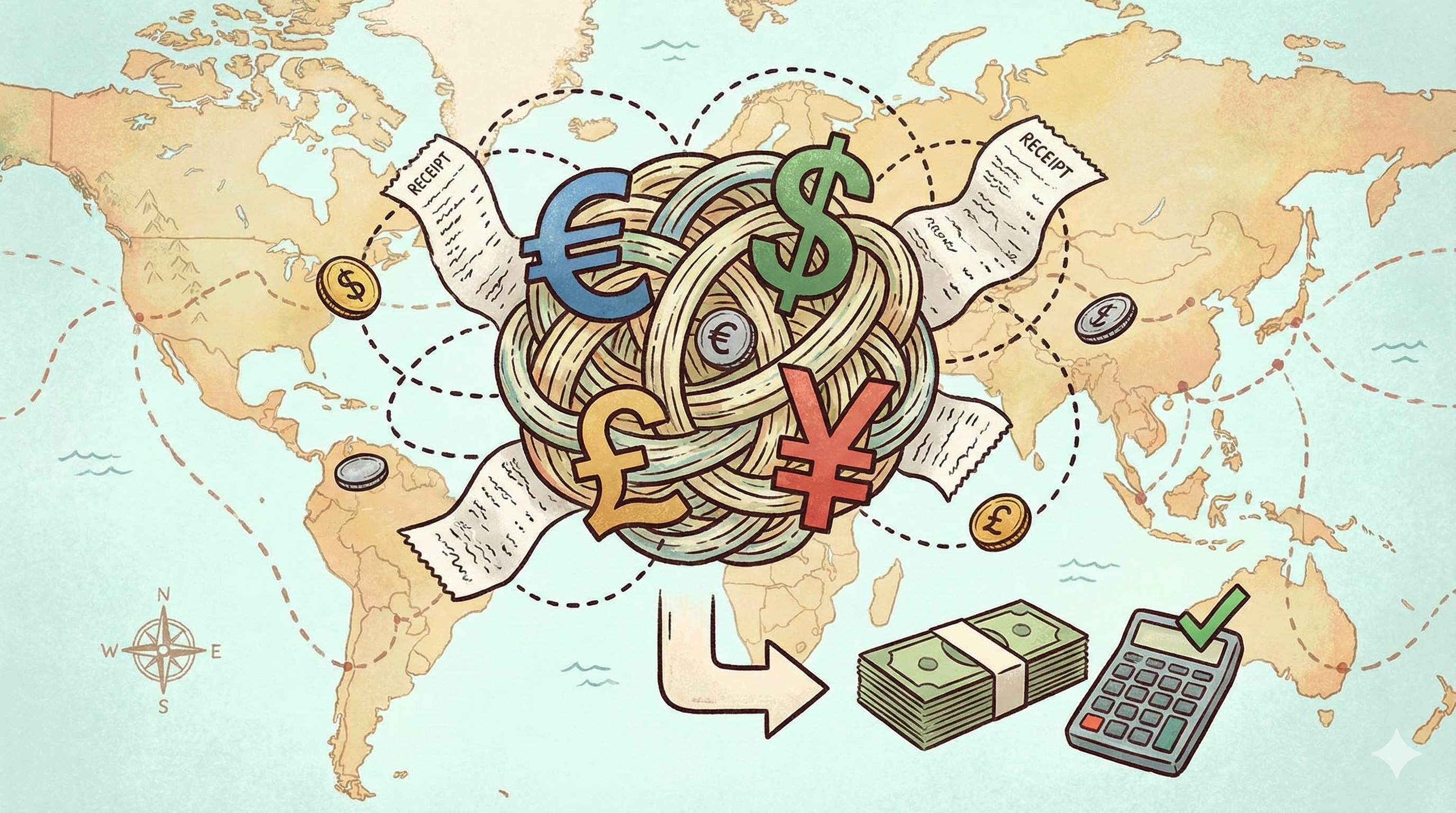
The "European Summer" is a rite of passage. You start in London, hop the train to Paris, maybe swing down to Switzerland, and end up in Italy. It sounds dreamy until you look at your bank statement.
Suddenly, you have paid for a round of pints in Pounds (£), a museum ticket in Euros (€), and a fondue dinner in Swiss Francs (CHF).
Then your friend Bob, who lives in Chicago and thinks in US Dollars, wants to know exactly how much he owes you for his share of the fondue.
If you are trying to do this math on the back of a napkin after two glasses of wine, you are going to get it wrong. Nothing kills a post-vacation buzz faster than an argument over exchange rates.
Here is how to manage expenses across multiple countries without needing a degree in international finance.
1. Pick a "Home Base" Currency Immediately
Before the plane wheels leave the tarmac, agree on one thing: What currency are we settling up in?
If you all live in the US, the answer is USD. If you are a mix of international friends, pick the most stable currency among you. Usually, that means USD or Euros.
The mistake groups make is trying to pay back "like for like." If Alice pays 50 Euros for dinner, Bob shouldn't try to hand her 50 Euros in cash three days later. Why? Because Alice doesn't want loose change. She wants the money back in her bank account to pay her credit card bill.
The Rule: Convert everything to the Home Base currency instantly.
2. Stop Paying with Cash (Seriously)
I know. It looks cool to peel off bills from a stack of colorful foreign money, but cash is the enemy of group accounting.
If you pay for a group taxi with cash, there is no digital paper trail. Even worse, you usually end up with a pocket full of heavy coins that you can’t exchange back when you get home.
The Strategy: Designate one person to pay for the big ticket items on a credit card. It’s cleaner, trackable, and you get the points. Save the cash for your personal gelato habit.
3. Don't "Guesstimate" the Exchange Rate
"The Euro is basically 1-to-1 with the Dollar, right?"
That sentence is the famous last words of a man who lost $200.
Exchange rates fluctuate daily. If you spent £100 on theater tickets on Tuesday, the cost in Dollars is different than it is on Friday. When you try to "ballpark" it, someone always loses money.
The Fix: Use the rate from the day of the transaction. Don't look it up a week later when you're back home.
4. Use a Tool That Does the Math For You
Okay, this is the part where we stop pretending you are going to do this manually. You are on vacation. You should be looking at the Colosseum, not a calculator app.
The easiest way to handle this is to log the expense exactly as it happened. If the bill was 4,500 Japanese Yen, type "4,500 JPY" into your planning app.
(Shameless plug: We just updated PlanAwesome to handle this specifically. You can now select the currency for every single expense, whether it's Mexican Pesos or Thai Baht, and our system automatically pulls the daily exchange rate and converts it to your group's base currency. No math required.)
5. The "One-Way" Settlement Rule
The biggest headache in multi-country trips is the "debt loop."
You owe Alice €20. Alice owes you £15. Bob owes you both $10.
Do not try to swap money back and forth for every little coffee. Wait until the very end of the trip. Let the expenses pile up in the app. At the end, let the algorithm simplify the debt so that maybe, just maybe, you only have to make one payment to one person to settle everything.
The Bottom Line Traveling to multiple countries is an adventure, but managing the money shouldn't be.
Don't let mental math ruin the magic. Log the expense in the local currency, let the technology handle the conversion, and focus on more important things. Like figuring out how to say "Check, please" in three different languages.